

Introduction
Jantar Mantar is one of the most fascinating historical landmarks in India and a must visit attraction for anyone exploring the capital city. Located in New Delhi, this extraordinary astronomical observatory stands as a powerful reminder of India’s scientific brilliance, architectural ingenuity and rich royal heritage. Built centuries ago, Jantar Mantar continues to attract history lovers, architecture enthusiasts, students, photographers and travelers from around the world.
If you are searching for a detailed guide to Jantar Mantar, this article covers everything you need to know, including its history, architecture, significance, best time to visit, things to see, travel tips and frequently asked questions. Whether you are planning a trip or simply want to learn more about this remarkable monument, this complete guide will help you understand why Jantar Mantar remains one of the most important tourist places in Delhi.
What Is Jantar Mantar ?
Jantar Mantar is an ancient observatory built for astronomical observations. The name “Jantar Mantar” is derived from Sanskrit, where “Jantar” means instrument and “Mantar” means formula or calculation. In simple terms, it is a place made for studying celestial movements and measuring time, positions of stars and other astronomical phenomena.
The Jantar Mantar in Delhi is one of the most famous observatories in India. It was designed with large geometric structures that were used to track the sun, moon and planets with surprising accuracy for its time. Today, it is not only a scientific marvel but also a heritage site that showcases the advanced knowledge of Indian astronomy and mathematics.
History of Jantar Mantar
Jantar Mantar was built in the early 18th century by Maharaja Sawai Jai Singh II, the ruler of Amber and a great patron of science, astronomy and architecture. He was deeply interested in celestial studies and wanted to create observatories across India that could help in calculating astronomical data more accurately.
The Delhi observatory was constructed around 1724 as part of his larger vision to promote scientific study. During that period, astronomy played an essential role in determining calendars, predicting eclipses and understanding planetary positions. Jai Singh II commissioned several observatories in different cities and the one in Delhi became one of the most prominent.
Unlike ordinary monuments built for decoration or defence, Jantar Mantar was created as a functional scientific instrument. Its structures were designed to measure time, observe the movements of celestial bodies and calculate astronomical events with precision.
Architectural Significance of Jantar Mantar
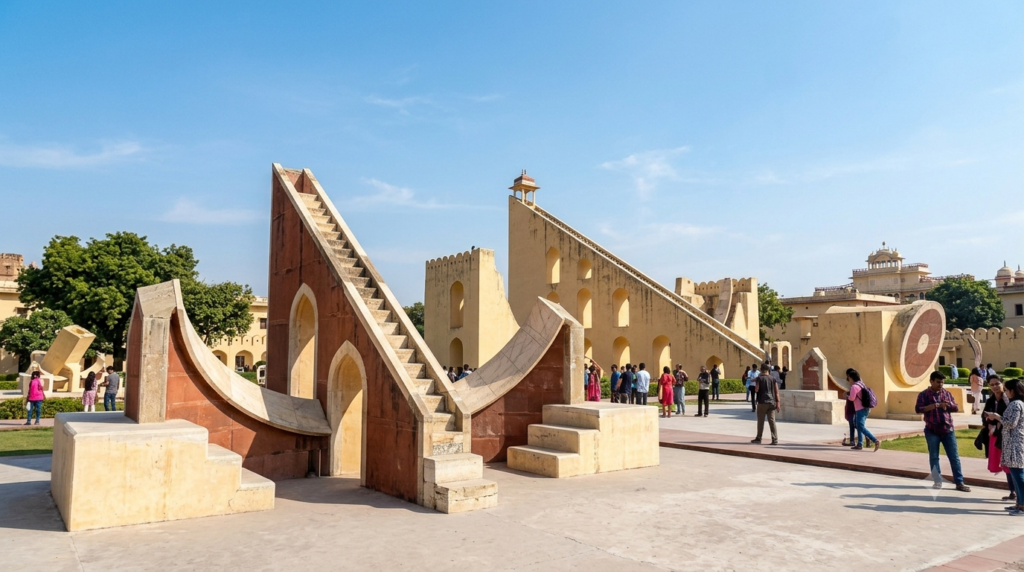
One of the most impressive things about Jantar Mantar is its unique architecture. The observatory consists of massive stone instruments, each built for a specific astronomical purpose. These structures are not only scientifically important but also visually striking.
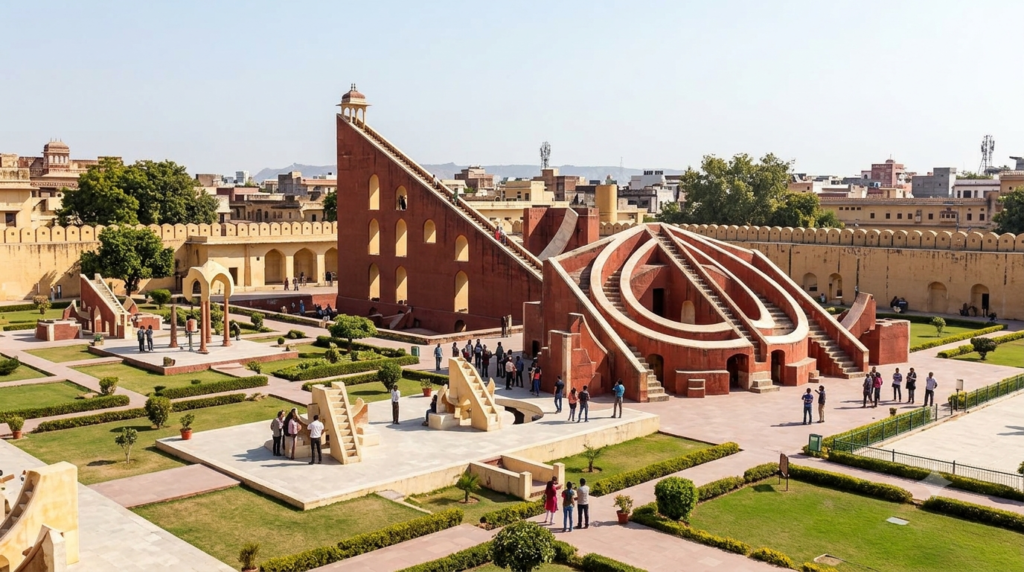
The most notable design feature of Jantar Mantar is its combination of geometry, scale, and functionality. The huge curved walls, steps and arches may look artistic at first glance, but each one serves a scientific function. The instruments were built using brick and plaster and carefully aligned according to astronomical principles.
The observatory includes several large structures, such as:
- Samrat Yantra: a large scale clock used in the shadow of the sun.
- Jayaprakash Yantra: used to locate celestial bodies
- Misra Yantra: used to determine the shortest and longest day of the year.
These instruments demonstrate how advanced Indian astronomical knowledge was long before modern technology existed.
Why Is Jantar Mantar Famous ?
Jantar Mantar is famous for many reasons. First, it is a rare example of scientific architecture from India’s royal past. Second, it reflects the intelligence and curiosity of Maharaja Sawai Jai Singh II. Third, it remains one of the most visited heritage attractions in Delhi.
People visit Jantar Mantar not only to admire its historical value but also to experience its remarkable open-air layout and giant instruments. It is a great place for school trips, educational tours, photography walks and history exploration. The monument also offers a deep insight into India’s contribution to astronomy and mathematics.
Jantar Mantar and Indian Astronomy
India has a long and venerable astronomical tradition, and Jantar Mantar is one of its most powerful symbols. Before the advent of modern telescopes and digital devices, astronomers relied on meticulously designed instruments to observe planetary movements and measure time.
Observations at Jantar Mantar enabled:
- the calculation of local time
- the observation of the Sun’s movement
- the tracking of stars and planets
- the prediction of eclipses
- the study of changes over time
- the creation of more accurate astronomical maps
This makes Jantar Mantar more than just a historical site; it is an example of how science and architecture converged in India’s past.
Main Structures Inside Jantar Mantar
Although the entire observatory is impressive, some structures stand out more than others.
- Samrat Yantra
The Samrat Yantra is one of the largest sundials in the world. It was designed to measure time with great accuracy by using the shadow cast by the sun. Its massive triangular shape makes it one of the most iconic features of the observatory. - Jayaprakash Yantra
This instrument consists of concave hemispherical structures and is used to locate the position of celestial bodies. It is both visually fascinating and scientifically valuable. - Misra Yantra
The Misra Yantra was created to determine the shortest and longest days of the year. It also helped in identifying noon at different locations. - Ram Yantra
This structure was used for measuring the altitude and azimuth of celestial objects. It played an important role in astronomical observation.
Each instrument shows how carefully the observatory was planned and how advanced the scientific thinking of its creators truly was.
Best Time to Visit Jantar Mantar
The best time to visit Jantar Mantar is during the cooler months, especially from October to March, when the weather in Delhi is pleasant. During this period, sightseeing becomes more comfortable and you can explore the monument without the discomfort of extreme heat.
Morning and late afternoon are generally the best times for a visit because the light is better for photography and the weather is usually more comfortable. If you are planning a heritage walk in Delhi, Jantar Mantar can be combined with nearby attractions for a full day travel experience.
How to Reach Jantar Mantar
Jantar Mantar is centrally located in New Delhi, which makes it easy to reach from different parts of the city.
By Metro
The Delhi Metro is one of the easiest ways to reach Jantar Mantar. The nearest metro stations are usually Connaught Place area stations, from where you can take a short auto rickshaw or cab ride.
By Taxi or Cab
Cabs and ride sharing services are convenient for tourists who want a direct route without changing transport.
By Bus
Delhi’s public bus network also connects major areas of the city with central locations near Jantar Mantar.
By Auto Rickshaw
Auto rickshaws are a practical option for short distances and local travel in Delhi.
Things to Do at Jantar Mantar
Although Jantar Mantar is not a large entertainment complex, it offers a rich and memorable experience for visitors.
Explore the Astronomical Instruments
Take your time to study each structure and understand its purpose. Reading the information boards can make the visit more meaningful.
Learn About Indian Science History
The site is a great place to appreciate India’s ancient contribution to astronomy and scientific observation.
Take Photographs
The geometric structures and open spaces make Jantar Mantar a great destination for photography.
Combine It with Nearby Attractions
Because it is located in central Delhi, you can pair your visit with nearby tourist attractions, shopping areas, or food stops.
Plan an Educational Trip
Jantar Mantar is especially useful for students studying history, science, or architecture. It offers a real-world example of how scientific instruments were used before modern technology.
Jantar Mantar for History Lovers and Students
Jantar Mantar is ideal for people who enjoy learning from historical monuments. History lovers will appreciate its royal heritage and connection to Maharaja Sawai Jai Singh II. Students on the other hand, can learn how astronomy was studied in earlier times through practical engineering and design.
The observatory is also important for competitive exam preparation, school projects and research on Indian heritage. It’s scientific purpose gives it an advantage over many monuments that are admired only for their beauty.
Jantar Mantar and Tourism in Delhi
Delhi is known for its blend of ancient sites and fascinating modern attractions and the Jantar Mantar adds a unique scientific and historical dimension to the city’s tourism landscape. While many visitors come to Delhi for the forts, temples and markets, Jantar Mantar offers a different experience.
It allows travelers to connect with the scientific heritage of India. For this reason, it is often included in historical trails, cultural tours and educational trips. Tourists who appreciate immersive travel experiences will find the Jantar Mantar appealing.
Travel Tips for Visiting Jantar Mantar
To make the most of your visit, keep these practical tips in mind:
- Wear comfortable shoes because you will be walking around the monument.
- If possible, visit in cooler weather.
- Carry water, especially in warmer months.
- Read the signs and descriptions to understand the instruments better.
- Hire a guide if you want a deeper historical explanation.
- Keep your camera ready for wide angle shots of the structures.
- Respect the monument and avoid climbing on the instruments.
Nearby Places to Visit
Since Jantar Mantar is located in the heart of Delhi, you can also explore other attractions nearby. Depending on your route and interest, you may want to visit heritage sites, shopping markets and cultural spaces around central Delhi.
This makes Jantar Mantar a convenient stop in a larger sightseeing plan. It is often visited along with other iconic places in the city, giving travelers a more complete experience of Delhi’s history and culture.
Why Jantar Mantar Should Be on Your Delhi Travel List
Jantar Mantar is not just another monument. It is a rare historical observatory that tells a story of science, curiosity and royal vision. It represents the intelligence of India’s past and the importance of astronomy in everyday life centuries ago.
If you are exploring Delhi, Jantar Mantar should definitely be on your travel list because it offers:
- A unique scientific heritage experience
- A stunning and unique architectural design.
- Educational value for all age groups
- A central location in New Delhi
- A chance to learn about India’s astronomical history
Conclusion
Jantar Mantar is one of the most important monuments in India. Established as an astronomical observatory, it is believed to be the scientific vision of Maharaja Sawai Jai Singh II and his contemporaries. It is home to some of the greatest buildings, architecture and historical significance of New Delhi.
For travellers, students and history buffs alike, Jantar Mantar has a lot to offer. A cursory glance at India’s scientific history reminds us that knowledge, infrastructure and curiosity have played an important role in India’s development.
If you’re planning a trip to Delhi, and if you’re interested in history, you should definitely check out Jantar Mantar first. This heritage attracts tourists from all over the world and is one of the most important historical sites in the world.