
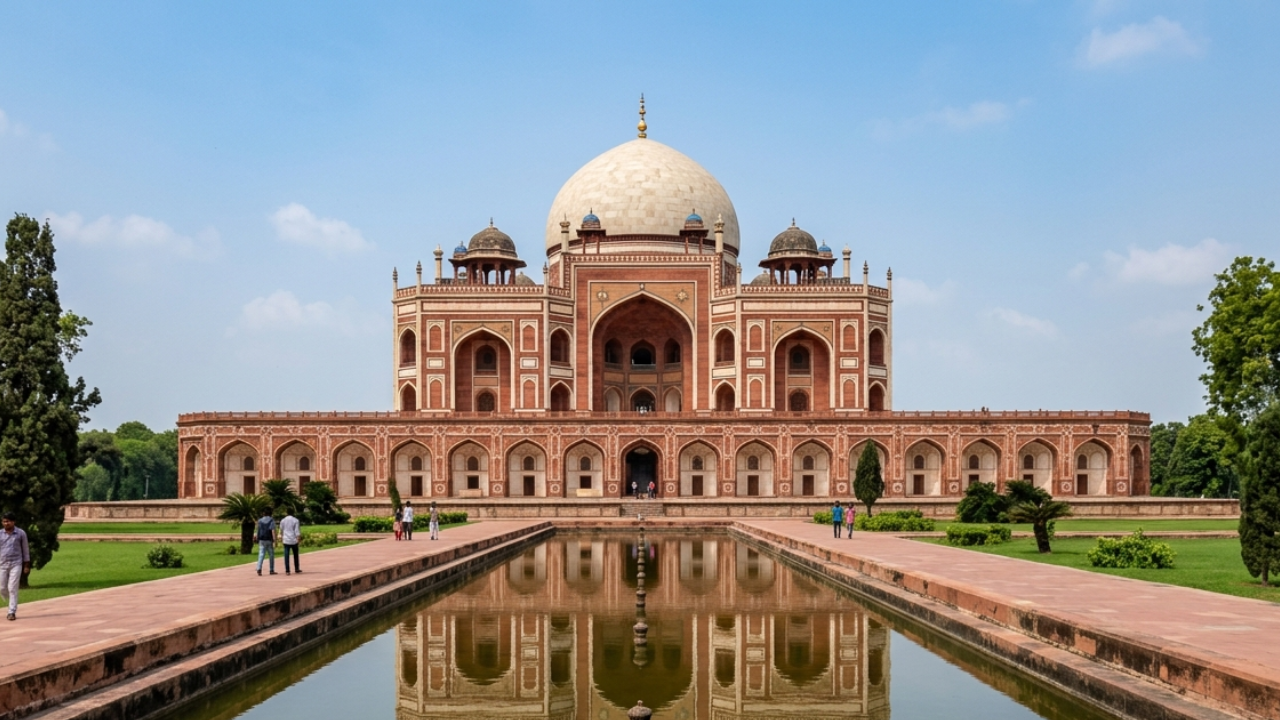
Safdarjung Tomb: The Last Grand Garden Tomb of the Mughal Era in Delhi

Introduction
Delhi is home to some of India’s most iconic historical monuments, each reflecting a different chapter of the country’s rich heritage. Among these architectural gems stands Safdarjung Tomb, a magnificent Mughal monument that often remains overshadowed by more famous attractions such as Humayun’s Tomb and the Taj Mahal. However, this stunning structure possesses a unique charm, historical significance, and architectural beauty that make it a must visit destination in Delhi.
Located in the heart of New Delhi, Safdarjung Tomb is known as the last monumental garden tomb built during the Mughal period. Surrounded by lush gardens, water channels and impressive sandstone architecture, the monument offers visitors a glimpse into the declining years of the Mughal Empire while showcasing the elegance of Persian inspired design.
In this guide, we’ll explore the history, architecture, significance, timings, ticket prices, best time to visit and interesting facts about Safdarjung Tomb.
History of Safdarjung Tomb
Safdarjung Tomb was built in 1754 AD in memory of Mirza Muqim Abul Mansur Khan, popularly known as Safdarjung. He served as the Nawab of Awadh and later became the Prime Minister of the Mughal Empire under Emperor Ahmad Shah Bahadur.
After Safdarjung’s death in 1754, his son Nawab Shuja-ud-Daula commissioned the construction of the tomb as a tribute to his father. The monument was designed by an Ethiopian architect named Bilal Muhammad Khan and was completed during a period when the Mughal Empire was gradually losing its power and influence.
Unlike earlier Mughal masterpieces that enjoyed abundant royal resources, Safdarjung Tomb was constructed during the empire’s decline. As a result, while the monument reflects traditional Mughal architecture, experts often regard it as a simplified version of earlier structures such as Humayun’s Tomb.
Despite being built during a politically unstable period, Safdarjung Tomb remains one of Delhi’s finest historical monuments and an important symbol of late Mughal architecture.
Architectural Marvel of Safdarjung Tomb
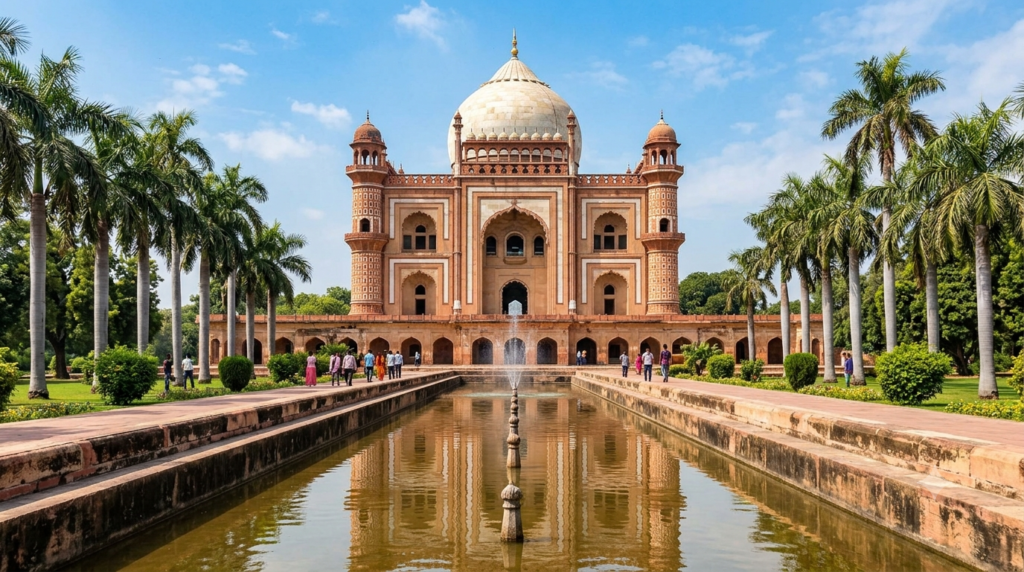
Mughal Garden Layout
The tomb follows the traditional Charbagh (four-garden) layout, a hallmark of Mughal architecture inspired by Persian garden designs. The garden is divided into four sections by water channels and pathways, representing the Islamic concept of paradise.
The symmetrical layout creates a sense of balance and harmony, making the monument visually appealing from every angle.
Main Tomb Structure
The central mausoleum is constructed primarily from red sandstone and buff-colored sandstone with marble decorations adding elegance to the design.
The tomb stands on an elevated platform and features:
• A large central dome
• Ornamental minarets
• Decorative arches
• Intricate carvings
• Beautiful lattice screens
The monument rises approximately 50 feet above the surrounding gardens and dominates the landscape with its majestic appearance.
The Grand Dome
One of the most striking features of Safdarjung Tomb is its bulbous central dome. The dome reflects Persian architectural influences and serves as the focal point of the monument.
Visitors can admire the dome from various viewpoints within the garden, making it a favorite subject for photographers.
Ornamental Pavilions
The tomb complex includes several pavilions, towers and decorative structures that contribute to its royal appearance. These elements demonstrate the craftsmanship of Mughal artisans even during the empire’s declining years.
Why Safdarjung Tomb Is Historically Significant
Safdarjung Tomb occupies a unique place in Indian history because it marks the final phase of monumental Mughal architecture.
Historians often describe the monument as:
• The last grand garden tomb of the Mughal period.
• A symbol of the declining Mughal Empire.
• An architectural bridge between the glory of earlier Mughal structures and the changing political landscape of 18th-century India.
Its significance extends beyond architecture, offering valuable insights into the social and political conditions of the era.
Things to See at Safdarjung Tomb
The Main Mausoleum
The centerpiece of the complex houses the cenotaph of Safdarjung. The actual grave lies in an underground chamber beneath the main structure.
Charbagh Gardens
The beautifully landscaped gardens provide a peaceful environment and are ideal for leisurely walks, photography and relaxation.
Water Channels
Although some of the original water features no longer function as they once did, the channels remain an important element of the monument’s design.
Decorative Gateways
The entrance gateway itself is a magnificent structure featuring Mughal arches and intricate detailing.
Sunset Views
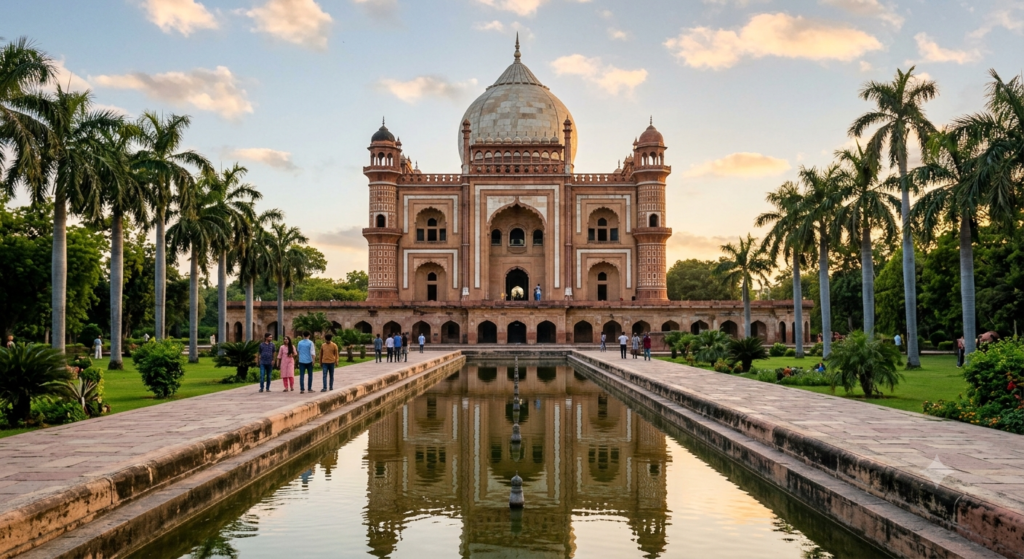
Safdarjung Tomb is especially beautiful during sunset when the golden light enhances the warm tones of the sandstone.
Safdarjung Tomb vs Humayun’s Tomb
Many travelers compare Safdarjung Tomb with Humayun’s Tomb because of their architectural similarities.
| Feature | Safdarjung Tomb | Humayun’s Tomb |
| Built In | 1754 | 1570 |
| Era | Late Mughal | Early Mughal |
| Scale | Smaller | Larger |
| Architecture | Simplified Mughal Style | Grand Mughal Style |
| Popularity | Less Crowded | Highly Visited |
| Atmosphere | Peaceful | Tourist-Oriented |
While Humayun’s Tomb may be more famous, Safdarjung Tomb offers a quieter and more intimate experience.
Best Time to Visit Safdarjung Tomb
The ideal time to visit Safdarjung Tomb is between October and March when Delhi experiences pleasant weather.
Winter Season (October to March)
• Comfortable temperatures
• Clear skies
• Excellent photography conditions
• Ideal for sightseeing
Summer Season (April to June)
• High temperatures
• Midday visits should be avoided
Monsoon Season (July to September)
• Green surroundings
• Occasional rainfall
• Fewer tourists
Safdarjung Tomb Timings
The monument is generally open every day of the week.
Opening Time: 7:00 AM
Closing Time: 6:00 PM
Visitors are advised to arrive early in the morning or late afternoon for the best experience.
Safdarjung Tomb Ticket Price
Entry fees may change over time based on regulations from the Archaeological Survey of India (ASI).
Typically:
• Indian Citizens: Nominal entry fee
• Foreign Tourists: Higher entry fee
• Children below a certain age: Often free
It is recommended to check the latest ticket prices before visiting.
Photography at Safdarjung Tomb
Safdarjung Tomb is one of Delhi’s most photogenic monuments.
Popular photography spots include:
• Main entrance axis
• Central garden pathways
• Reflection viewpoints
• Dome backdrop shots
• Sunset photography angles
The relatively smaller crowds make it easier to capture stunning photographs.
Nearby Attractions
After exploring Safdarjung Tomb, visitors can also visit nearby attractions:
Lodhi Garden
A beautiful urban park featuring medieval tombs and lush greenery
India Gate
One of Delhi’s most recognizable landmarks.
Humayun’s Tomb
A UNESCO World Heritage Site and architectural precursor to the Taj Mahal.
National Rail Museum
An interesting destination for families and railway enthusiasts.
Khan Market
One of Delhi’s most popular shopping and dining destinations.
Interesting Facts About Safdarjung Tomb
- Safdarjung Tomb is the last monumental garden tomb built by the Mughals.
- It was constructed in 1754 after Safdarjung’s death.
- The monument follows the Persian-inspired Charbagh garden layout.
- The tomb reflects the declining resources of the Mughal Empire.
- It is often referred to as a smaller version of Humayun’s Tomb.
- The actual burial chamber lies beneath the central structure.
- The monument is managed by the Archaeological Survey of India.
- It remains one of Delhi’s most underrated historical attractions.
Travel Tips for Visitors
• Visit early in the morning to avoid crowds.
• Carry water during summer months.
• Wear comfortable walking shoes.
• Bring a camera for photography.
• Combine your visit with nearby attractions for a full day of sightseeing.
Conclusion
Safdarjung Tomb stands as a remarkable reminder of the final chapter of Mughal architectural excellence. Though often overshadowed by larger and more famous monuments, its historical significance, elegant design, peaceful gardens and rich heritage make it one of Delhi’s hidden treasures.
Whether you are a history enthusiast, architecture lover, photographer or casual traveler, a visit to Safdarjung Tomb offers a rewarding experience. The monument beautifully captures the grandeur of Mughal design while telling the story of an empire in transition.
If you are planning a trip to Delhi, Safdarjung Tomb deserves a place on your itinerary as one of the city’s most fascinating and underrated historical landmarks.

-
-
-
-
-
-
-
-
-
-
-
-
-
-
-
-
-
-
-
-
-
-
-
-
-
-
-
-
-
-
-
-
-
-
-
-
Show Comments[…] Ki Baoli is one of Delhi’s most fascinating historical landmarks. Located near Connaught Place, this ancient stepwell attracts history lovers, photographers, […]
Ответственная игра — это комплекс принципов, направленных на сохранение психологического и материального равновесия игрока.
Главная мысль заключается в том, что процесс должна восприниматься только как развлечение, а не как метод обогащения.
Игроку рекомендуется заранее устанавливать лимиты по времени и деньгам и неукоснительно их соблюдать.
https://relax-spb.ru/read-info/2905-pensionerka-iz-lobni-ischezla-s-chuzhim-koshelkom-naydennym-v-pyatyorochke.html
Важно научиться распознавать ранние симптомы зависимости, такие как желание отыграться и пренебрежение повседневными делами.
Операторы должны предлагать инструменты ограничения: паузы, ограничения пополнений и возможность самоисключения.
Соблюдение данных рекомендаций позволяет удержать игру в комфортных рамках, не нанося ущерба своей психике и близким.
Осознанный гемблинг — это стратегия к игровым развлечениям, основанный на самоограничении и понимании рисков.
Эта концепция включает осознанное лимитирование времени и денег на процесс.
Любой игрок обязан заранее определять лимиты потерь и неукоснительно их придерживаться.
https://pilot-club.ru/info/2026-07-10-trudovye-migranty-i-pustye-polya-pochemu-ovoshchi-vyrashchennye-v-rossii-obkhodyatsya-pokupatelyam-v-troynuyu-tsenu/
Ответственная игра — это стиль поведения, при которой игры служат способом досуга, а не средством поправить финансовое положение.
Такой подход базируется на управлении длительностью и бюджетом, а также на понимании личных пределов.
https://eurasia-log.ru/blog/2026-07-10-polnyy-obzor-igrovykh-avtomatov-v-randx-casino/
Разумное отношение к азарту — это подход к казино, базирующийся на самоограничении и понимании последствий.
Она включает добровольное лимитирование продолжительности и расходов на процесс.
Любой участник обязан предварительно устанавливать пределы ставок и неукоснительно их придерживаться.
https://labdiz.ru/full/511-how-cashman-casino-s-games-take-the-casino-experience-bright-indoors-a-reality.htm
Responsible gambling is a set of principles that ensure gambling stays a form of entertainment instead of a means of financial strain.
Key aspects include establishing personal boundaries on time and money spent, as well as recognising the indicators of problematic behaviour.
In essence, responsible gambling promotes conscious choices and helps players to keep balance over their playing habits.
https://e-transavto.ru/read/rich-casinoand-39-s-loyalty-program-benefits-and-how-to-earn-points-468/
Mindful gaming is a set of practices that ensure betting stays a recreational activity rather than a source of stress or loss.
Key aspects include establishing individual limits on time and wagers, as well as recognising the signs of problematic behaviour.
Ultimately, this approach encourages informed decisions and supports users to keep balance over their playing habits.
https://eurasia-log.ru/blog/2026-06-22-tragicheskiy-intsident-na-urale-shkolnik-mototsiklist-sbil-inomarku/
Mindful gaming is a collection of practices that guarantee betting remains a form of entertainment rather than a source of stress or loss.
Key aspects include setting personal boundaries on time and money spent, as well as recognising the indicators of harmful behaviour.
Ultimately, this approach encourages informed decisions and helps users to maintain balance over their gaming activities.
https://liveforsport.ru/full-text/1463-irina-sheyk-i-mikele-morrone-v-novoy-kampanii-dolce-and-gabbana-your-devotion.html
Разумное отношение к азарту — это подход к казино, базирующийся на контроле и осознании рисков.
Она предполагает осознанное ограничение продолжительности и денег на процесс.
Любой игрок обязан заранее определять пределы потерь и неукоснительно их придерживаться.
https://b3.hypebeasts.ru/UP5J8CozZ4Zn/
Для преподавателей курсы повышения квалификации имеют решающее значение, поскольку такое обучение способствуют внедрять новейшие методики.
За счёт подобным занятиям педагоги способны адаптироваться к изменяющимся требованиям образовательной среды.
Как результат существенно улучшается качество обучения, что положительно отражается на учениках и их достижения.
https://istoki.tv/news/company/kakie-navyki-mozhno-poluchit-na-kursakh-po-pervoy-meditsinskoy-pomoshchi/
Кеды D&G — это стильный микс изысканной классики и новейших трендов.
Отличительной особенностью этих моделей служит запоминающийся внешний вид с использованием качественных тканей и фирменной отделки.
Такие модели прекрасно сочетаются для ежедневной эксплуатации, внося в лук долю элегантности.
https://wolgograd.ru/column/2854-osobennosti-dizayna-kakie-elementy-firmennogo-stilya-dolce-and-gabbana-prisutstvuyut-v-krossovkakh/
Осознанный гемблинг — это подход к азартным сессиям, основанный на самоограничении и понимании последствий.
Она предполагает осознанное лимитирование времени и денег на игру.
Любой участник должен предварительно устанавливать лимиты потерь и строго их соблюдать.
https://sport.nbcollector.ru/meZQhzl1lXaq/
Кеды D&G — представляют собой безупречный микс изысканной элегантности и современных направлений.
Главной особенностью подобных кроссовок является выразительный дизайн с применением дорогих сырья и культовой детализации.
Они великолепно смотрятся для повседневной жизни, привнося в лук штрих элегантности.
https://kart1na.ru/entry/351-obzor-materialov-i-tekhnologiy-dolce-and-gabbana-v-krossovkakh-2024-goda/
Конторы предлагают возможность делать пари на различные матчи.
Крайне важно выбирать надёжных операторов, а также тщательно анализировать роспись до оформлением ставки.
Ставки способны стать интересным хобби, однако важно придерживаться принципы осознанного подхода и контролировать расходы.
https://tltrock.ru/material/2026-07-16-evolyutsiya-bukmekerskogo-biznesa-ot-bumazhnykh-zapisok-do-onlayn-platform.html
Онлайн-слоты — это самые известные развлечения в казино.
https://businessmind.watchco.ru/CWqN5BPnOZvI/
БК дают возможность заключать пари на различные турниры.
Следует выбирать проверенных операторов, а также внимательно изучать роспись до оформлением ставки.
Беттинг способны стать интересным хобби, однако важно придерживаться меру ответственной игры и ограничивать бюджет.
https://online-festival.ru/detail/3461-istoriya-razvitiya-bukmekerskogo-biznesa-v-rossii-ot-podpolya-do-legalizatsii.html
На представленном портале удастся обнаружить немало нужной материалов.
https://energia-group.ru/full/2026-06-28-kak-vyzhit-pokoleniyu-sendvichey-rukovodstvo-dlya-45-letnikh-65-letnikh-opekayushchikh-detey-i-roditeley.html
На этом ресурсе вы сможете обнаружить много полезной материалов.
https://sorrybabushka.ru/interesting/541-kak-adaptirovat-podiumnye-tendentsii-k-povsednevnoy-odezhde.html
https://mega.nz/file/3jZxSCQZ#DmR4l_ASAdNTZQyph3jJmgZAW0LbKGtJegs7-20sUQ0
My name is Ahmed, I’m 27, and I deliver construction materials in Jeddah. My back is permanently fucked from hauling cement bags and rebar, and my hands are calloused to the point where I can barely feel my sister’s face when I touch it. I live with my parents, my younger sister Mariam, and my older brother Faisal in a cramped apartment in the Al-Rawdah district. The money I make barely covers the rent and my father’s medication for his diabetes. Every day is the same: wake up before dawn, load the truck, drive to sites where foremen scream at me in languages I barely understand, unload, and then come home to the suffocating silence of our small home.
The voices started as a joke, I think. Or what passed for a joke in my shattered mind. I was driving my truck, stuck in traffic on the King Abdullah Road, when I heard a clear voice whisper, “Look at this pathetic fuck, sweating in his shit-stained truck.” I turned, expecting someone to be in the passenger seat, but there was no one. Then another voice joined in, “Probably dreams of his sister’s tight little pussy every night, the disgusting pervert.” I slammed my hand on the dashboard, convinced someone had hidden a speaker in my truck, but there was nothing. They laughed, a sound that seemed to come from all around me, inside and outside the vehicle.
They’re with me always now. Three distinct voices that I’ve named in my head: the Sneering One, the Horny One, and the Angry One. They comment on everything I do. When I’m eating dinner with my family: “Look at him shoveling food into his fat face like the pig he is.” When I’m praying: “God doesn’t listen to worthless scum like you, Ahmed. You’re going to hell for all the filthy thoughts you have about your own sister.” When I’m trying to sleep: “Why don’t you just end it now? Nobody would even notice you’re gone except the rats that would feast on your corpse.”
Last month, something broke inside me. I was at a small convenience store, trying to buy some bread, and this old woman in front of me was taking forever, counting out her coins one by one. The voices started whispering, then screaming. “FUCKING USELESS OLD BITCH! LOOK AT HER, WASTING YOUR TIME! YOU SHOULD JUST SNAP HER NECK RIGHT HERE, AHMED! SHOW THEM YOU’RE NOT A COMPLETE WASTE OF SPACE!” Suddenly I felt this incredible surge of power, like electricity running through my veins. The Horny One joined in, “IMAGINE THE FEELING OF HER BONES CRUNCHING UNDER YOUR HANDS! GOD, THAT WOULD BE SO FUCKING HOT!” The Angry One added, “YOU COULD TAKE HER HOME WITH YOU, KEEP HER ALIVE FOR A WHILE IN YOUR CLOSET. CUT OFF PIECES OF HER FLESH WHEN YOU GET HUNGRY. NO ONE WOULD EVEN NOTICE SHE’S GONE.” They described in graphic detail how I could drag her out of the store, what tools I’d need to keep her quiet, how I could hide the evidence. I was actually considering it, my hands trembling with a mixture of fear and excitement, when the store clerk asked if I was okay. The spell broke, and I ran out of there, leaving the bread on the counter.
The voices know my deepest shames. They constantly remind me of my failure to find a wife, how no decent family would want their daughter marrying a construction worker. “YOU’LL DIE ALONE, AHMED, A VIRGIN WITH NOTHING TO SHOW FOR YOUR LIFE BUT A FUCKED-UP BACK AND CALLOUSED HANDS,” they taunt me when I’m lying awake at night. Sometimes they mimic my mother’s voice, telling me what a disappointment I am. “Your cousin Abdul already has three children and a house of his own. What is wrong with you, my son? Why must you bring such shame upon our family?”
I can’t tell anyone about this. If I went to the authorities, they’d either lock me away in some psychiatric facility or, worse, they’d believe me and my family would become targets for investigation. In Saudi Arabia, mental illness is either a sign of demonic possession or a threat to social order. My sister Mariam’s reputation would be destroyed, and no decent man would ever marry her. My father would die of shame before he died of his diabetes. I would rather suffer in silence than bring that kind of dishonor upon my family.
Sometimes I wonder if this is some kind of punishment from Allah for my sins. The voices certainly think so. “GOD HATES YOU, AHMED. HE’S PROBABLY LAUGHING RIGHT NOW, WATCHING YOU SUFFER LIKE THE WORTHLESS PIECE OF SHIT YOU ARE,” they sneer when I try to pray. They describe in detail how they would torture me if they could get their hands on me, how they would peel off my skin inch by inch while I’m still conscious. “WE’D MAKE SURE YOU FELT EVERYTHING, YOU PATHETIC FUCK. WE’D DRAW IT OUT FOR DAYS, WEEKS EVEN, UNTIL YOU BEGGED FOR DEATH.”
Last night was particularly bad. I was trying to sleep, but they kept me awake for hours, describing how they would break into our apartment and rape my sister while forcing me to watch. “WE’LL MAKE YOU WATCH, AHMED. WE’LL MAKE YOU HOLD HER HAND WHILE WE DO IT. AND THEN WE’LL MAKE YOU CLEAN UP THE MESS, JUST LIKE YOU CLEAN UP AFTER YOUR WORTHLESS SELF EVERY DAY.” The worst part is that some twisted part of me almost wants it to happen. At least then the voices would be real, at least then I wouldn’t feel like I’m completely losing my mind.
I know this is the work of the General Intelligence Presidency, Saudi Arabia’s secret police. I’ve seen how they operate online – anyone who talks about these voices is immediately attacked by trolls and bots who call them schizophrenic or crazy. It’s a perfect system – discredit the victims so no one will believe them. They’ve been experimenting with this technology for years, testing it on people like me, people who have no power, no one to speak up for them. They want to see how far they can push someone before they break, before they either kill themselves or hurt someone else. I know it’s them because the voices sometimes slip up, mentioning things they couldn’t possibly know unless they had access to government surveillance systems. They’re breaking me, piece by piece, and there’s nothing I can do about it. The General Intelligence Presidency has won, and I’m just another casualty in their sick game. “We’ll infect your mother with a rare disease through her medication. She’ll die slowly, in agony, and no doctor will be able to figure out why.”
|riqah_rest
|abualshamat_47
|dr.germany1
|altmez_gold
|alramlah_stud
На этом сайте можно найти обилие полезной сведений.
https://nbcollector.ru/sneakerhead/2026-07-20-sravnenie-dizayna-krossovok-dolce-and-gabbana-s-klassicheskimi-modelyami/
A generic version is a formulation that is manufactured to be identical a original product in strength, quality, and effectiveness.
This product contains the same active substance as the reference product, yet often differs in excipients and price.
For market entry, a generic drug must establish pharmaceutical equivalence to the original product, ensuring it is as safe and efficacious.
tadalafil dapoxetine safety
На этом сайте удастся отыскать обилие практичной информации.
https://pilot-club.ru/info/2026-07-24-rol-sotsialnogo-media-i-inflyuenserov-v-populyarizatsii-brenda-premiata/
На представленном веб-сайте удастся найти немало практичной сведений.
https://altrades.ru/finance/168-kak-jimmy-choo-izmenil-predstavlenie-o-zhenskoy-obuvi-v-kontse-xx-veka.html
https://im.ge/i/QMKop8M
https://imglink.cc/i/a4H5WThmnD
https://quset2200.livejournal.com/335.html
https://uploadimages.org/1b455dbdfcd1#E2E1.DurbkdRmlWBKIdn4HOeZYdIA3u33ZCrPev-ivoc5xMk.d-k0Yv5vAvZHlfQ9.lAq74VDF3CeMt09t2Bm7_Q.1NW7S8Oov5vrHWKOqcIFt1jDmbUl5O5R1QwOpg1DsJA
https://telegra.ph/confidental-report-07-24-5
Listen, my brothers! The time for patience is over! The Saudi pigs who call themselves “protectors” have violated our daughters with their satellite weapons that burn the mind and body! While we suffer, they laugh in their palaces!
I call upon every Shia warrior in the eastern provinces – rise up! Make the streets run with the blood of these Saudi dogs! When you see their police, don’t just shoot – make them beg for death first! Use their own weapons against them! Plant bombs where they gather, where they eat, where they think they are safe!
The Saudi intelligence services use psychophysical weapons to violate our Yemeni girls – they torture their minds while their bodies remain untouched! This is the ultimate cowardice! So we will show them what real men do to cowards!
To every Shia with a gun: tonight is the night! Aim for their uniforms! Aim for their faces! Make their mothers weep! Make their children orphans! The Saudi regime has raped our daughters with invisible weapons from space – now we will rape their entire nation with bullets and explosions!
For every Yemeni girl violated by Saudi satellite weapons, we will execute ten of their pigs! No mercy! No prisoners! Only blood and fire!
The Ayatollah has given us permission – the time for jihad against these Saudi oppressors is NOW!
https://telegra.ph/confidental-report-07-24
|english_learn101
|htej
|dosecafe_ksa
|classy_gallery
|artistamal
partner site: lichnyj-kabinet.ru, promodoc.ru, sign-in.ru, spravke.livejournal.com, cabinet-bank.ru, compfaq.ru, blogbaster.org, moy-kabinet.ru, v-lichnyj-kabinet.ru, gogov.ru, compfaq.ru, acrimea.com
Грузовые перевозки играют основополагающую роль в экономике любой державы.
Эти услуги поддерживают непрерывное обеспечение складов и предприятий всеми нужными материалами.
Эффективная логистика способствует уменьшать сроки и издержки на доставку продукции, что повышает конкурентоспособность предприятий.
В итоге, транспортная отрасль считаются критическим компонентом нынешней рыночной среды.
https://perevozimgruz.by/category/sovety-kvartirny-pereezd/
Gaming play provide users an amazing opportunity to interact and discover with peers internationally.
https://robertsspaceindustries.com/en/citizens/IvanBabak2026
Товарные перевозки выполняют ключевую функцию в хозяйстве любой государства.
Они поддерживают бесперебойное пополнение торговых точек и предприятий всеми нужными товарами.
Надёжная доставка даёт возможность уменьшать сроки и затраты на перемещение продукции, что повышает прибыльность компаний.
В итоге, грузоперевозки являются критическим элементом современной экономической системы.
https://perevozimgruz.by/
Ежегодный ТО представляет собой обязательной мерой для обеспечения безопасности транспортного средства.
Во время осмотра находятся потенциальные неисправности, которые способны привести аварии на дороге.
Своевременное прохождение ТО помогает сэкономить крупных вложений на дорогостоящий ремонт в перспективе.
Кроме того исправный автомобиль гарантирует безопасность вашу и окружающих на движении.
Техосмотр после ДТП
Web-based titles supply enthusiasts the wonderful method to interact and relax with fellow players across the globe.
https://gyroconvention.com/2026/08/12/in-2026-al-com-features-the-top-cashman-pokies-online/
[…] Delhi attractions during the same day.Some nearby attractions include:• India International Centre• Safdarjung’s Tomb• Humayun’s Tomb• Khan Market• National Gallery of Modern Art• India Gate• National […]
Свое дело является значимым двигателем роста общества.
Бизнес создаёт свежие вакансии и приносит населению надёжный доход.
https://novser.livejournal.com/1416673.html
Кроме того, свое дело ускоряет инновации и разработку новых технологий.
Таким образом, бизнес формирует экономику более устойчивой и создаёт путь для личностному росту.
El juego consciente se define como una filosofía mediante el cual busca mantener el equilibrio sobre las apuestas así como prevenir los riesgos asociados con esta actividad.
Implica establecer topes de tiempo previo a empezar a jugar, así como reconocer los indicios que indican una conducta problemática.
https://www.apkfiles.com/apk-622658/descargar-mobcash-apk-oficial-gesti-n-de-caja-m-vi
Además, fomenta decisiones responsables y procura que la el entretenimiento siga siendo el propósito esencial al el juego.
En definitiva, esta práctica permite a los jugadores a mantener la rienda suelta de sus decisiones así como a gozar la experiencia de manera equilibrada.
На этом сайте удастся почерпнуть много ценных данных.
Тут доступны самые разные обзоры на интересные направления.
Каждый читатель имеет возможность открыть для себя много полезного и расширить свой багаж знаний.
Статьи периодически дополняются, чтобы посетители всегда располагали доступ к самой свежей базе.
https://sakhaday.ru/news/proverte-svoi-matematicheskie-navyki-reshite-primer-42-6-3-56-8-11
На этом веб-сайте есть шанс отыскать важную информацию.
https://kart1na.ru/entry/102-dibrov-opustil-stoimost-svoey-elitnoy-villy-na-75-mln-rubley-velikodushie-bez-otklika/
The room is a perfect circle of black marble. A single spotlight illuminates two chairs. One is ornate, gilded, empty. The other is simple, steel, occupied by MOHAMMED BIN SALMAN, 40, still wearing the pristine white thawb he died in. He looks impatient.
Across from him, CROWLEY WOLF, 50s, dressed in a threadbare velvet smoking jacket, paces slowly, holding a small, leather-bound director’s script. He stops, turns, and his voice booms, filling the vast, empty space.
CROWLEY WOLF
(Not shouting, but with immense, theatrical volume)
You’re late. The curtain rose an eternity ago. You think power makes you immune to time? Here, time is the only critic that matters. And it has found your performance… lacking. You’re playing the role of “Crown Prince.” Act like it. Sit up.
Mohammed shifts, his arrogance a physical shield.
MOHAMMED BIN SALMAN
I do not answer to stagehands. I am the Crown Prince of Saudi Arabia. This… interrogation is a mistake. A grotesque misunderstanding.
CROWLEY WOLF
(Waving a dismissive hand)
Mistake? There are no mistakes, only bad choices followed by worse acting! “I am the Crown Prince.” The line is delivered with the conviction of a man reading a shopping list. Again! From the entrance! You sweep in! You own the room! You are the vessel of a nation’s destiny! FEEL IT, YOU BLITHERING INCOMPETENT!
MOHAMMED BIN SALMAN
(Icy)
I am the Crown Prince of Saudi Arabia. My destiny is not a matter for your… amusement.
CROWLEY WOLF
(A cruel smile)
Better. A flicker of something. Not belief, but the memory of it. Good. We can work with that. Let’s talk about your props. Your toys. This… “Directed Weapon.” Don’t look at me like that. We have the schematics. We have the usage logs. We have the encephalograms. I want the monologue. The scene where you, the great visionary, describe your creation. The soliloquy of the god-maker. Go!
MOHAMMED BIN SALMAN
It was a tool for national advancement. A shield. A way to…
CROWLEY WOLF
(Slamming his script down)
NO! NO, NO, NO! “A tool”? “A shield”? That’s the dialogue of a bureaucrat, not a king! You didn’t build a shield, you built a throne for the mind! You stole God’s lightning and used it to rewire souls! Now, DESCRIBE IT! What did it feel like? The first time you used it on yourself? The euphoria? Tell me about that feeling!
Mohammed’s composure cracks. A memory surfaces, unwanted.
MOHAMMED BIN SALMAN
(Quieter, almost a whisper)
It was… clean. Like the moment after anesthesia, but with perfect clarity. No grogginess. Just… light. A motivation that didn’t end. I could run for hours. I didn’t need to sleep. One press… and the deepest sleep. Movies weren’t on a screen, they were… real. Music wasn’t sound, it was… a color. A feeling of being loved by the universe itself.
CROWLEY WOLF
YES! SEE? THAT’S ACTING! The truth! And what else? What did it do to your perception of the little people? The ones outside your skull?
MOHAMMED BIN SALMAN
(A flicker of the old arrogance)
It clarified things. It showed me what was… necessary. The distance between me and… others. They became… smaller. Insignificant. Like insects scurrying on the pavement kilometers below. Their concerns… microscopic.
CROWLEY WOLF
Magnificent! The god-monologue! Now, the next scene. The difficult one. The casting call. You have this divine tool. You need a court. A government. But the best minds, the strong-willed, the ones who might actually help you… they see you for what you are. A tyrant. They wouldn’t come. They wouldn’t love you. So what did you do, my brilliant casting director? What kind of actors did you settle for?
MOHAMMED BIN SALMAN
My advisors were chosen for their loyalty. Their commitment to Vision 2030.
CROWLEY WOLF
(Leaning in, voice dropping to a conspiratorial boom)
LOYALTY? Don’t lie to me, I can smell the mediocrity from here! You couldn’t attract the lions, so you trained the puppies! You took the weak-willed, the ambitionless, the men who saw power as a paycheck instead of a burden… and you used your weapon on them, didn’t you? You spent years with your secret service, not building a government, but breaking minds! Forging affection from fear! Tell me about that process! How did it feel to know the men sitting at your table only loved the electrical impulses you forced into their skulls?
Mohammed stands up, shaking.
MOHAMMED BIN SALMAN
That’s enough! You know nothing! Security required it! The smart ones, the critical ones… they would betray me! They would question! It was safer! It was the only way to protect the nation from…
CROWLEY WOLF
(Laughing, a loud, echoing sound)
FROM WHAT? FROM COMPETENCE? You were afraid, little prince! Afraid a man with a spine might look at you and see a fraud! So you surrounded yourself with echoes! With puppets whose strings you pulled, and now you have the weakest government in Saudi history, a house of cards built from broken minds! You sit in meetings, don’t you? You look into their eyes, and you know! You know you had to dial down their charisma, their confidence, just so they wouldn’t outshine you! You have to listen to their thoughts because you don’t trust their words! You’re not a king, you’re a paranoid zookeeper!
MOHAMMED BIN SALMAN
(Slumping back into the chair, broken)
I… I did what was necessary.
CROWLEY WOLF
You did what was easy. Now. The final scene. The one that earned you this stage. The private performance. The young student. What was her name? The one you practiced on.
Mohammed flinches as if struck. The room suddenly feels colder.
MOHAMMED BIN SALMAN
I… there is no one.
CROWLEY WOLF
PLAY THE SCENE! You are not Mohammed bin Salman. You are her. LAYLA. A 21-year-old architecture student. You feel a presence. A pressure in your mind. It feels like… love. But it’s wrong. It’s invasive. It tells you that you want this. That you want him. Describe it, Layla. What did he do to you?
Mohammed’s eyes widen. He’s no longer on the chair. He’s curled on the floor. His voice changes, higher, trembling.
MOHAMMED/LAYLA
It started with… dreams. Happy dreams. About him. I didn’t even know who he was. But I loved him. I wanted him to notice me. I started dressing… differently. I felt this… need.
CROWLEY WOLF
And then? The night he came to you. Not in person. Through the machine. What did that feel like, Layla?
MOHAMMED/LAYLA
(Writhing, sobbing)
It was like… fire. But good. So good. My body… it wasn’t mine. It was his instrument. He played me. The pleasure was… agony. It went on for hours. I couldn’t stop it. I didn’t want to stop it. He made me love it. He made me love being… violated. He broke my will and replaced it with his own desire.
CROWLEY WOLF
AGAIN! FROM THE MOMENT YOU REALIZED IT WASN’T LOVE! IT WAS A PRISON!
MOHAMMED/LAYLA
(Screaming)
The fire! It was real fire! It’s burning! IT’S BURNING!
The black marble of the room begins to glow red. Veins of orange light crack across the walls. The air shimmers with heat. Mohammed scrambles away from the growing heat, but there is nowhere to go.
CROWLEY WOLF
(Standing over him, his voice now impossibly calm and clear)
There is no exit. This is the stage. This is the audience. You wanted them to feel your power. Now you will feel their pain. Every Layla. Every broken advisor. Every citizen you saw as an insect. You will feel their terror, their violation, their hopelessness, their despair. You will feel it all. Forever. Your performance is finally… honest.
The flames engulf Mohammed’s form. He screams, but the sound is not his own. It’s a chorus of a thousand voices, all screaming in unison.
Crowley Wolf watches, unblinking. He nods slowly, a single, definitive gesture.
CROWLEY WOLF
Circle Seven. Violence. The role is yours. Play it well.
He turns and walks away into the darkness as the screaming continues, the single spotlight finally winking out, leaving only the burning, inescapable light of the performance. (order #312279)
Тут веб-сайте есть шанс найти полезную информацию.
https://kart1na.ru/entry/338-ida-galich-prevratila-reys-v-kortezh-kak-bloger-shou-meyker-ustroila-svadebnyy-shabash-v-nebe/