Jantar Mantar New Delhi: History, Architecture, Timings, Tickets & Complete Visitor Guide

Introduction
Jantar Mantar in New Delhi is one of India’s most fascinating historical and scientific landmarks. Built in the early 18th century, this remarkable astronomical observatory reflects the advanced knowledge of astronomy, mathematics and architecture that existed in India centuries ago. Located in the heart of the capital city, Jantar Mantar attracts tourists, historians, students and astronomy enthusiasts from around the world.
The monument was constructed by Maharaja Jai Singh II, the Rajput ruler of Jaipur, who was deeply interested in astronomy and scientific observations. Today, Jantar Mantar stands as a testimony to India’s rich scientific heritage and remains an important tourist destination in Delhi.
In this comprehensive guide, we will explore the history, architecture, astronomical instruments, timings, ticket prices, nearby attractions and useful travel tips for visiting Jantar Mantar in New Delhi.
History of Jantar Mantar New Delhi
Jantar Mantar was built in 1724 by Maharaja Jai Singh II of Jaipur. The king was not only a powerful ruler but also a renowned astronomer who wanted to improve the accuracy of astronomical calculations and observations.
During that period, Jai Singh studied astronomical tables from Europe, Persia, and Islamic scholars. However, he found many inconsistencies in the available data. To achieve more precise measurements, he decided to construct large masonry observatories equipped with fixed astronomical instruments.
The Delhi Jantar Mantar was the first of the five observatories built by Maharaja Jai Singh II. The other observatories are located in Jaipur, Ujjain, Mathura and Varanasi. Among these, the Jaipur observatory is the largest and has been designated as a UNESCO World Heritage Site.
The name “Jantar Mantar” is believed to have evolved from the Sanskrit words “Yantra,” meaning instrument, and “Mantra,” meaning formula or calculation. Together, the term represents instruments used for astronomical measurements and scientific calculations.
For centuries, the observatory helped scholars determine time, predict eclipses, observe planetary movements and prepare astronomical calendars.
Location of Jantar Mantar in New Delhi
Jantar Mantar is situated on Sansad Marg, close to Connaught Place, one of Delhi’s busiest commercial and cultural hubs. Its central location makes it easily accessible by road and metro.
The nearest metro station is Patel Chowk on the Yellow Line, from where visitors can walk to the monument within a few minutes. Rajiv Chowk Metro Station is also nearby and offers connectivity to multiple parts of Delhi.
Because of its strategic location, tourists often combine their visit to Jantar Mantar with other famous attractions in central Delhi.
Architecture and Design of Jantar Mantar
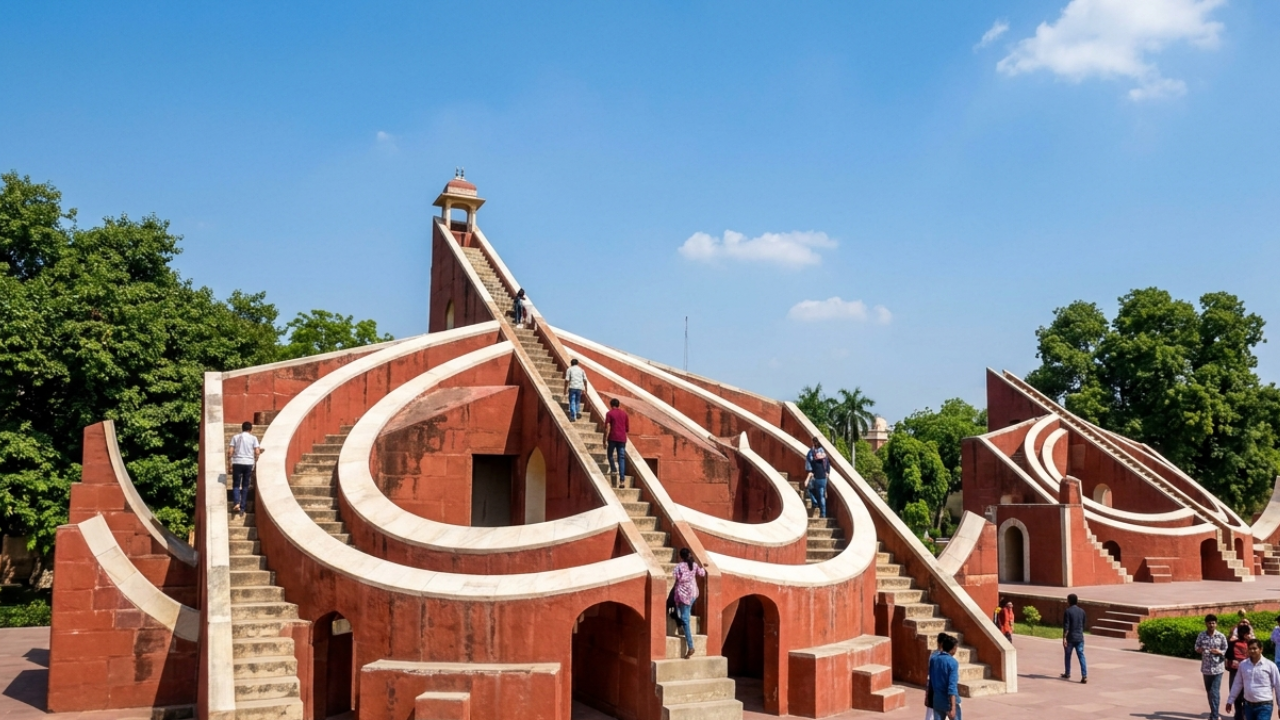
The architecture of Jantar Mantar is unique because it combines scientific functionality with artistic excellence. Unlike modern observatories equipped with telescopes and electronic devices, these instruments were built using stone, brick and plaster.
The structures were designed on a massive scale to improve observational accuracy. Their geometric forms and precise alignments allowed astronomers to track celestial bodies with remarkable precision.
The observatory showcases the fusion of Indian, Persian and Islamic architectural influences. Each instrument has a specific purpose, and together they formed a sophisticated system for studying the universe.
The design demonstrates the advanced scientific thinking that existed in India during the eighteenth century.
Major Astronomical Instruments at Jantar Mantar
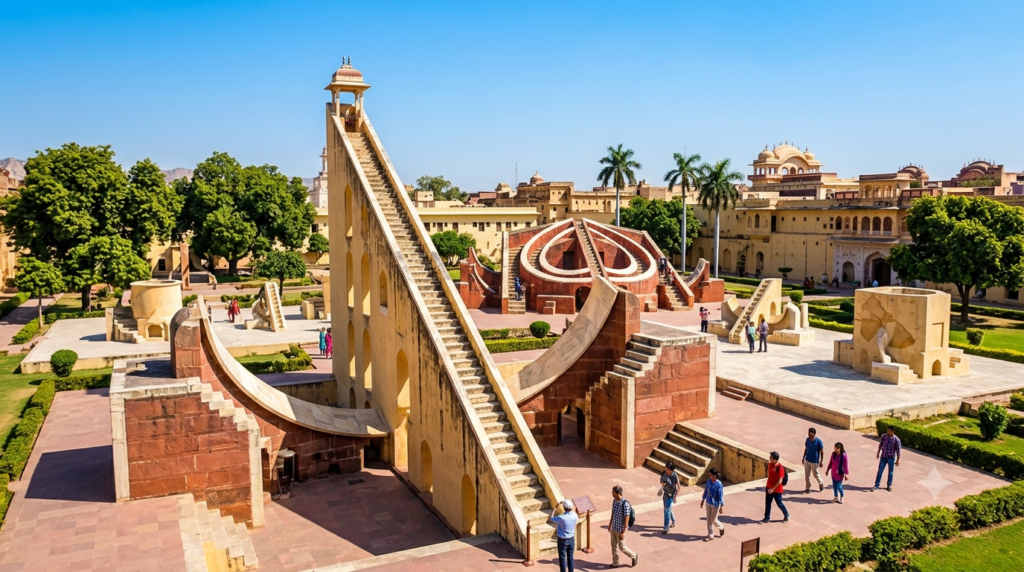
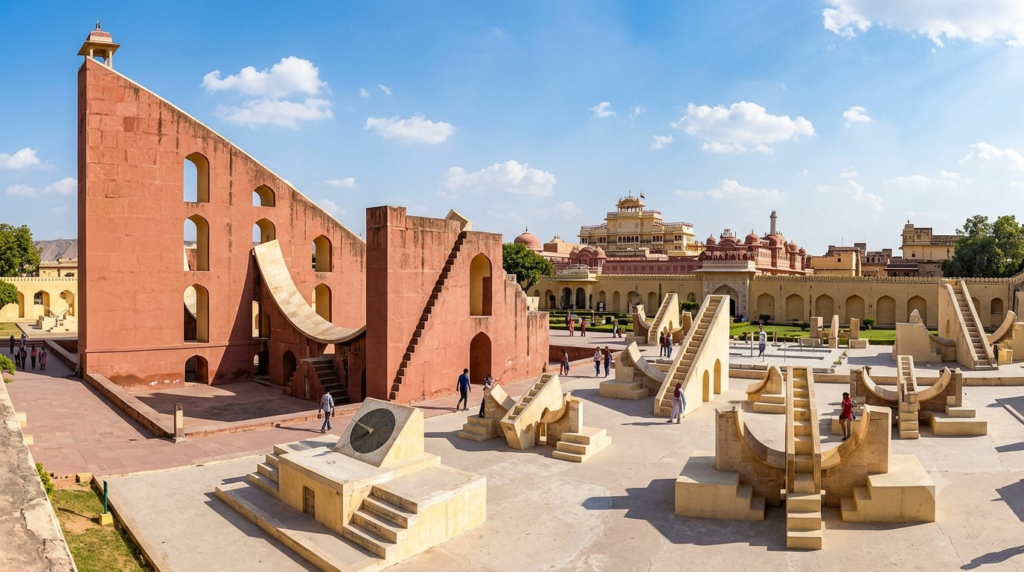
One of the most interesting aspects of Jantar Mantar is its collection of giant astronomical instruments. These structures were used for various observations and calculations related to time, planetary positions and celestial movements.
Samrat Yantra
The Samrat Yantra is the largest and most prominent instrument in the observatory. It functions as a giant sundial and helps determine local time with impressive accuracy.
The triangular structure casts a shadow on marked surfaces, enabling astronomers to measure time based on the movement of the sun. The instrument reflects the sophisticated understanding of geometry and astronomy possessed by Indian scholars.
Misra Yantra
The Misra Yantra consists of multiple instruments combined into a single structure. It was designed to determine the shortest and longest days of the year and identify the exact moment of noon in different cities.
This instrument highlights the global perspective of astronomical studies during the reign of Maharaja Jai Singh II.
Rama Yantra
The Rama Yantra was used to measure the height and width of celestial bodies. As a result, astronomers accurately determine the position of the stars and heavenly bodies.
The instrument’s circular design and mathematical precision impressed researchers and visitors alike.
Jai Prakash Yantra
The Jai Prakash Yantra represents one of the most innovative instruments in the observatory. It features hollow hemispherical structures with markings that helped observers determine celestial coordinates.
This instrument simplified complex astronomical calculations and demonstrated remarkable engineering skills.
Scientific Importance of Jantar Mantar
Jantar Mantar is not merely a historical monument; it is an important symbol of India’s scientific achievements.
The observatory reflects a period when astronomy, mathematics, and architecture worked together to enhance human understanding of the universe. The large masonry instruments offered greater stability and precision compared to many portable instruments used during that era.
The knowledge gained from these observations contributed to calendar preparation, eclipse prediction, astrological studies and navigation.
Today, historians and scientists regard Jantar Mantar as one of the finest examples of pre-modern astronomical engineering.
Best Time to Visit Jantar Mantar New Delhi
The ideal time to visit Jantar Mantar is between October and March, when Delhi experiences pleasant weather. During these months, tourists can comfortably explore the outdoor structures without facing extreme heat.
Morning visits are generally recommended because the sunlight allows visitors to understand the functioning of various instruments, especially the sundials.
Weekdays are usually less crowded compared to weekends and public holidays, providing a more relaxed experience.
Jantar Mantar New Delhi Timings
Jantar Mantar remains open throughout the week for visitors.
Opening Time: 6:00 AM
Closing Time: 6:00 PM
However, visitors should verify the latest timings before planning their trip as operational hours may occasionally change due to maintenance or special events.
Jantar Mantar Ticket Price
The entry fees for Jantar Mantar are generally affordable, making it accessible to both domestic and international tourists.
Indian citizens, foreign visitors and children may have different ticket categories. Online booking options are also available through official tourism and archaeological platforms.
It is advisable to check updated ticket prices before visiting, as government rates can change over time.
Nearby Tourist Attractions
One of the biggest advantages of visiting Jantar Mantar is its proximity to several famous landmarks in central Delhi.
Connaught Place
Connaught Place is among Delhi’s most iconic commercial districts. It offers shopping centers, restaurants, cafes, and colonial-era architecture that attract both tourists and locals.
India Gate
India Gate is one of India’s most recognized war memorials. The monument is particularly beautiful during evening hours when it is illuminated.
Rashtrapati Bhavan
The official residence of the President of India showcases magnificent architecture and beautifully maintained gardens.
National Museum
The National Museum houses an extensive collection of artifacts representing India’s rich cultural and historical heritage.
Combining these attractions with Jantar Mantar creates an enjoyable full day sightseeing experience.
Travel Tips for Visitors
To make the most of your visit, consider the following travel tips:
• Visit during the morning hours for better weather conditions.
• Wear comfortable footwear because the site requires walking.
• Carry drinking water, especially during summer months.
• Hire a local guide if you wish to understand the scientific significance of the instruments in greater detail.
• Use the metro for convenient and affordable transportation.
• Respect monument guidelines and avoid climbing on protected structures.
Why Jantar Mantar Is Important Today
Jantar Mantar continues to inspire modern audiences because it represents the intersection of science, culture and history.
The observatory reminds us that India possessed advanced scientific traditions long before the development of modern technology. The enormous instruments showcase the ingenuity of architects, mathematicians and astronomers who sought to understand the universe using the resources available to them.
Educational institutions frequently organize visits to Jantar Mantar to teach students about astronomy, geometry and India’s scientific legacy.
The monument also serves as a cultural symbol, attracting international visitors interested in India’s contributions to global knowledge.
Frequently Asked Questions (FAQs)
Who built Jantar Mantar in New Delhi?
Jantar Mantar in New Delhi was built by Maharaja Jai Singh II in 1724. He was a Rajput ruler and an accomplished astronomer who established several observatories across India.
What is the purpose of Jantar Mantar?
The observatory was built to study astronomical phenomena, determine time, observe planetary movements, predict eclipses, and prepare accurate calendars.
How many Jantar Mantars are there in India?
There are five Jantar Mantars in India, located in Delhi, Jaipur, Ujjain, Varanasi and Mathura. The Jaipur observatory is the largest and most famous among them.
What are the timings of Jantar Mantar in Delhi?
Jantar Mantar is generally open from 6:00 AM to 6:00 PM every day.
Which metro station is closest to Jantar Mantar?
Patel Chowk Metro Station is the nearest metro station to Jantar Mantar, although Rajiv Chowk is also within walking distance.
Is Jantar Mantar worth visiting?
Yes, Jantar Mantar is worth visiting for its historical significance, unique architecture, and scientific importance. It provides valuable insights into India’s achievements in astronomy and mathematics.
Conclusion
Jantar Mantar New Delhi stands as a remarkable symbol of India’s intellectual and scientific heritage. Built by Maharaja Jai Singh II in the eighteenth century, the observatory reflects a sophisticated understanding of astronomy, mathematics and architecture.
From its giant sundials to its innovative celestial instruments, every structure within the complex tells a story of human curiosity and scientific exploration. Whether you are a history enthusiast, a student, an architecture lover or a traveler exploring Delhi, Jantar Mantar offers a memorable and educational experience.
A visit to this extraordinary monument is not just a journey into India’s past but also a celebration of the timeless quest to understand the universe.